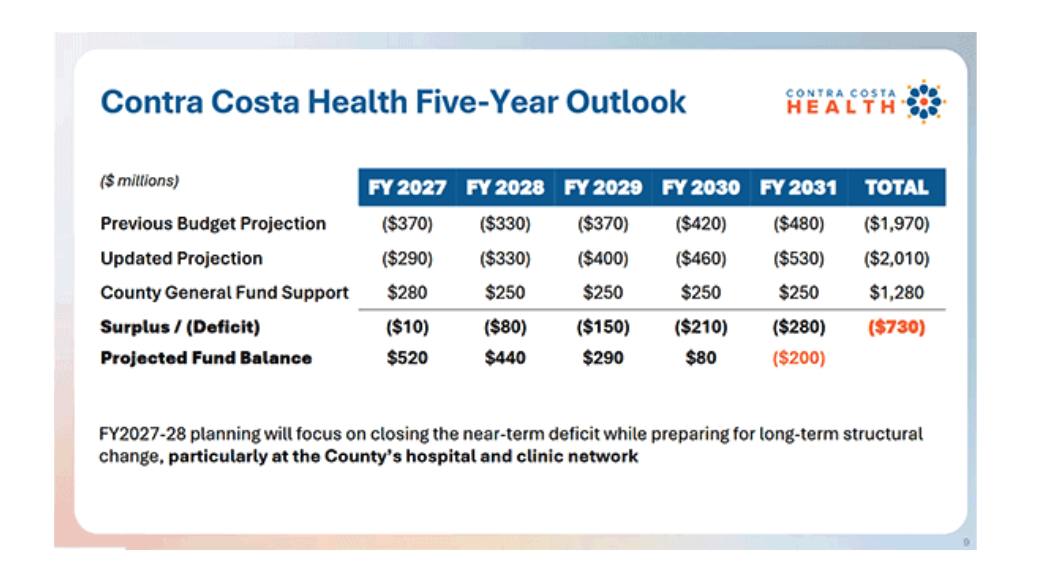
Contra Costa County's health system is staring down a $730 million budget shortfall over the next five years, driven by federal and state cuts to Medi-Cal that could leave as many as 93,000 county residents without insurance by 2031.
The Board of Supervisors heard a full report on the crisis Tuesday, Aug. 25, at 9 a.m. in Martinez. The figures come from a staff report first detailed by Contra Costa News on Monday. Three officials were scheduled to present: Dr. Grant Colfax, health services director; Andrew Murrell, chief financial officer; and David Culberson, chief executive officer of Contra Costa Regional Medical Center and Health Centers.
The county hospital and clinic network touches residents across Walnut Creek and surrounding cities. One in five county residents receives primary care at county clinics, and the regional medical center logged more than 38,000 emergency visits in the fiscal year ending June 2026. It also runs the county's only Psychiatric Emergency Services program.
What's driving the shortfall
The deficit is rooted in changes at both the federal and state level. H.R. 1, the federal spending package known as the "Big Beautiful Bill," combined with state Medi-Cal eligibility and reimbursement changes, will shrink both enrollment and funding.
By fiscal year 2028-29, Contra Costa Health projects annual losses of roughly $307 million: $159 million from residents losing Medi-Cal eligibility and $148 million from cuts to supplemental state and federal healthcare funding, according to a county fiscal update.
The most immediate hit: approximately 47,500 residents will no longer qualify for managed Medi-Cal starting Jan. 1, 2027, when state policy shifts people with certain immigration statuses from managed care to fee-for-service coverage, according to the staff report.
Hospital's future under review
County leaders are evaluating four scenarios for Contra Costa Regional Medical Center: maintaining the status quo, converting to a single-specialty behavioral health facility, pursuing multi-specialty growth, or winding down acute care services entirely and reinvesting in the community clinic network.
That last option is stark. It would end inpatient hospital care at the county's safety-net facility.
Health officials recommend the multi-specialty growth path, which would expand high-demand services and modernize operations. Leadership plans to update the board as the evaluation progresses, though no follow-up date has been set.
Near-term budget picture
The county has already made progress on the immediate gap. When the Board of Supervisors adopted the $7.248 billion county budget on May 19, Contra Costa Health carried an $80 million deficit. Cost-containment and productivity measures have since reduced that to $10 million for the current fiscal year.
Board Chair Diane Burgis said in May that the county was focused on protecting essential services and maintaining long-term fiscal stability amid the uncertainty.
In December 2025, then-Board Chair Candace Andersen was more direct: "These changes mean fewer people covered and fewer dollars coming into the system at the same time. Our responsibility is to face that reality head-on … and ensure the county continues to provide essential care for residents who have nowhere else to turn."
The Board of Supervisors also placed a five-year, five-eighths-cent general-purpose sales tax on the June 2026 ballot, projected to generate about $150 million annually. Voters rejected the measure, 57.41% to 42.59%, leaving that funding option off the table as the county confronts the larger shortfall.
What's next
The Aug. 25 agenda item asked supervisors to accept the report and provide guidance on next steps. No outcome from Tuesday's hearing had been reported as of this writing.